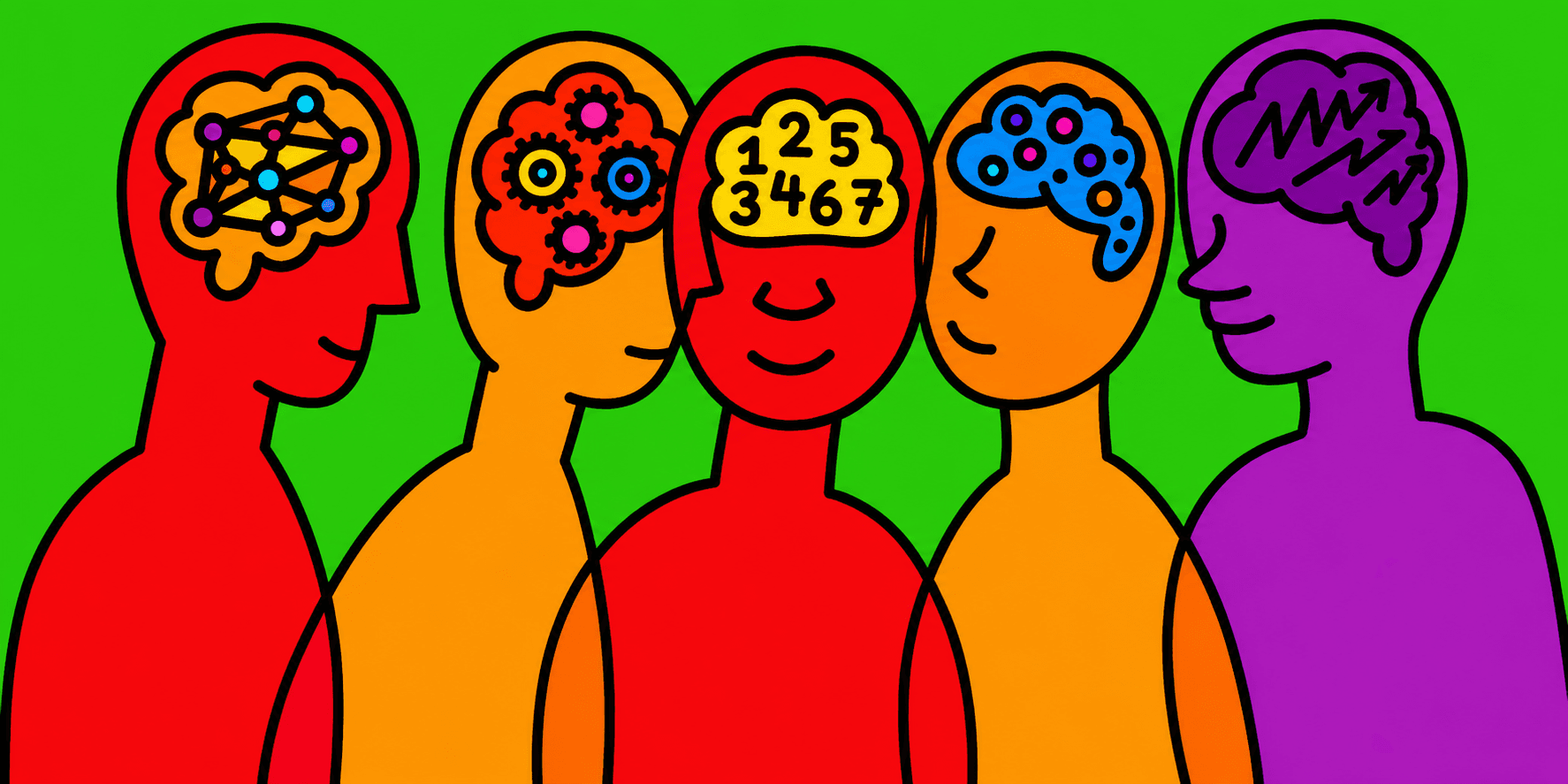
Imagine a team of young artists standing before a blank canvas. Each painter carries a palette of colours they know. This palette is not a matter of choice, but an accumulation of everything they have seen, everywhere they have been, and every problem they have had to solve before. The palette is not just their pigment, it’s their perspective.
Now imagine that in this group, each of them comes with the same palette. They are not untalented. They are not careless. But their colours are identical. No matter how many paintbrushes they use or how much they mix their colours, they will only end up with similar paintings. This is the quiet cost of cognitive uniformity, where even if a team of like-minded individuals is numerous, it can still function as a single mind.
This is what happens in many organisations. A group gathers to solve a problem, and without realising it, they are all working from the same cognitive palette. The result is not bad work. It is merely familiar work. The same answers, arrived at by different routes, to questions the group already knew how to ask.
How to cure the cognitive uniformity?
The antidote for cognitive uniformity is cognitive diversity, though it's widely misunderstood. Cognitive diversity is usually thought of as a matter of different opinions or different personalities. However, it actually refers to genuine differences in how people perceive problems, process information, and imagine solutions. Two people can look at the same situation and not just disagree about the answer, but represent the problem differently from the very beginning. One notices the people. Another focuses on structure. A third is drawn to what is absent rather than what is present. These are not random quirks. They are distinct cognitive tools.
Where does cognitive diversity comes from?
For a long time, psychology assumed that the machinery of human thought was largely universal. Our culture and childhood were thought to shape our preferences, but not the fundamental way we think. However, research has gradually dismantled that assumption. The way people categorise objects, reason about causality, understand time, and model other minds is shaped profoundly by the environments they grew up in, the languages they speak, and the knowledge passed down through their communities. Language alone restructures thinking as languages differ in, for example, how they encode spatial relationships, mark time, or distinguish shades of colour. These are not merely translation problems. They represent genuinely different ways of organising experience.
A person who navigated complex family structures from a young age, learned mathematics through a second language, and grew up in a strong oral storytelling tradition has developed ways of thinking that a team of similarly educated professionals from different backgrounds simply do not possess. The richness of what a team can think depends significantly on the richness of the lives its members have lived.
How to get the most out of cognitive diversity?
Here is where many organisations stumble. They achieve diversity in backgrounds and nationalities, and then discover, with some bewilderment, that their teams are not noticeably more creative. The palettes are varied. The painting still looks the same.
The reason is that diversity does not automatically become collaboration. Research on team creativity consistently shows that diverse teams outperform homogeneous ones only when they engage in genuine, sustained exchange of perspectives. People do not offer their most unusual ideas in environments where difference is merely tolerated rather than genuinely welcomed. So the goal is not just to tolerate different viewpoints, but to actively draw them out and allow those differences to change the group's thinking.
Better ideas rarely emerge from identical minds approaching problems in identical ways. But they do not emerge from diverse teams by accident either. When the conditions are right and when every palette is truly in use, when the quietest voice in the room is actively sought, a painting that emerges is one that no single painter could have imagined alone.

 May 18, 2026