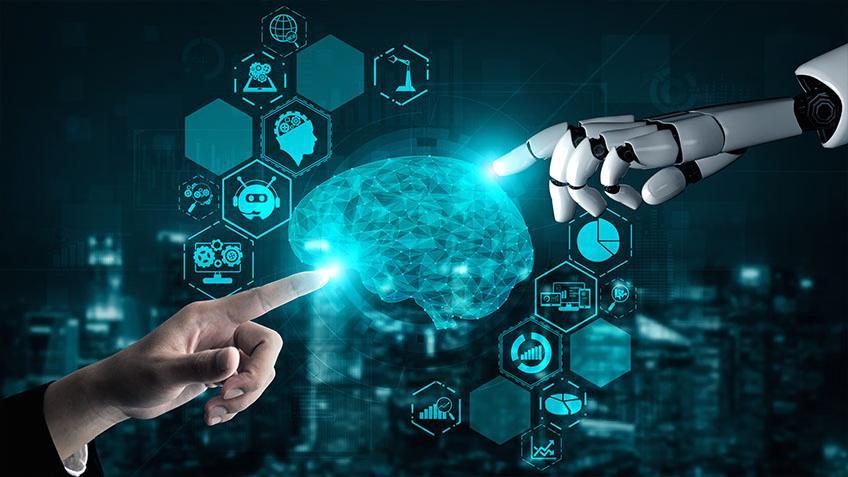
What exactly is the problem with artificial intelligence? Are we heading toward an Ex Machina-like scenario, where AI becomes more powerful than we expect and begins to replace our sources of livelihood one by one?
Actually, most workers in the Netherlands don’t see AI as an immediate threat. Data from Statistics Netherlands (2026) shows that 41% believe AI could partially do their jobs, while only 4% think it could fully replace them. However, this does not mean there is no risk, especially as workplaces become more heavily automated.
From Fiction to Reality: The AI Debate
The film industry has long been fascinated by the idea of AI versus humans. Ex Machina is one such example, telling the story of an advanced humanoid AI and its interactions with its human creators. What makes Ex Machina so unsettling is not just the intelligence of AI, but its ability to outthink humans socially, emotionally, and strategically. These are the very skills that define our humanness and shape how we function in our daily work with others.
Yes, AI is becoming increasingly sophisticated. It can hold conversations, perform complex calculations, and generate ideas. But it does so based on existing data, patterns, and inputs created by humans, without genuine emotional understanding. In that sense, its intelligence remains fundamentally mechanical.
So, the real question is not simply whether AI can take over jobs, but whether we are truly facing a future where machines replace human cognition, or simply overestimating AI’s capabilities.
The Strengths, Roles, and Trade-Offs of AI
To answer this, we need to clearly distinguish artificial intelligence from human intelligence and cognition. AI is faster, data-driven, and task-specific, whereas human intelligence is flexible, creative, and deeply rooted in meaning, emotion, and real-world understanding. Interestingly, the very skills AI still struggles with, such as creativity, critical thinking, and social intelligence, are the ones becoming increasingly valuable in today’s data-driven workforce, according to the World Economic Forum (2025).
If we look at where AI is most useful, it becomes clear that it benefits humans, especially in data-heavy roles such as healthcare, scientific research, data analysis, and strategic business positions. In these contexts, AI is not a replacement but a support tool. It automates repetitive tasks, increases efficiency, and handles processes that would take humans significantly more time. In that sense, AI functions as an extension of human cognition and capability.
However, this efficiency comes with trade-offs.
There are growing concerns about the environmental cost of AI, including high energy consumption, excessive water usage, and its contribution to climate change. Beyond that, there is a more subtle but equally important issue: the effect of automation on human cognition.
The Cognitive Costs of AI
As more tasks become automated, we risk offloading not just labor but thinking itself. Research by Risko and Gilbert (2016) on cognitive offloading shows that heavy reliance on external tools can weaken memory and critical thinking over time. This raises a deeper concern. Instead of using AI to enhance our thinking, we may begin to substitute it, putting ourselves in a position where we become reliant on AI to complete tasks.
The danger is gradual. The more we rely on AI without critical evaluation, the less we actively engage our own cognitive abilities. Over time, this can dull the very skills that distinguish human intelligence from artificial intelligence. In doing so, we may unintentionally make ourselves easier to replace, not because AI has fully surpassed us, but because we have reduced the gap between the two systems.
So, while AI may not be ready to replace us outright, the real risk lies in how we use it. If we rely on it passively rather than critically, we are not just changing how we work, we are also changing how we think. And that may be the more important shift when it comes to the future of work.

 Mar 21, 2025